From Missed Calls to Meaningful Connections: My First Hackathon Journey
How I learned that the best technology doesn't just work — it listens.
The Beginning: 50% GenZ, 100% Energy
It was my first hackathon as Team Vidyut — a bunch of Vidyutens, 50% GenZ, with one shared attitude: "Let's energize this hackathon."
The ONEST Hackathon by Deshpande Startups, EkStep Foundation, and Headstart Network Foundation gave me 4 days and one powerful problem statement:
Zero-Barrier Job Applications for Low-Tech Workers
Let low-tech workers find & apply for local jobs in under 2 mins using basic phone features. No app needed.
No app. No literacy required. Just access.
I didn't know it yet, but this challenge would teach me more than any classroom ever could.
The Solution: Technology That Speaks Your Language
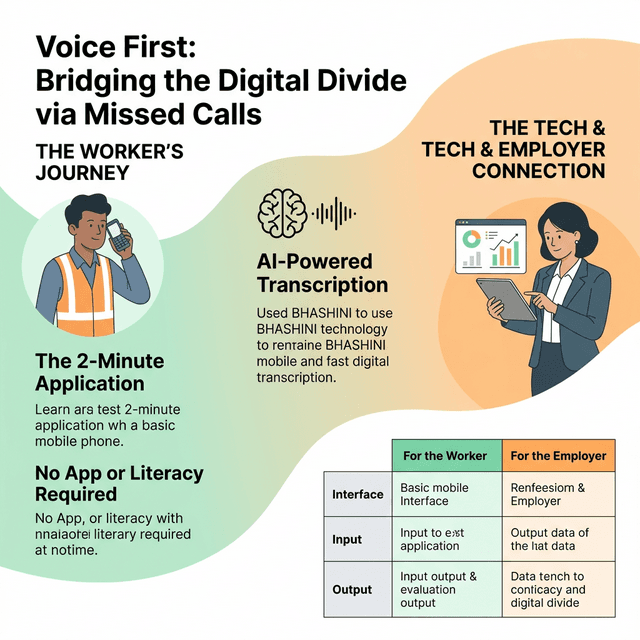
I built a voice-first system where anyone could apply for a job using just a missed call, SMS, or WhatsApp voice note.
Here's how it worked:
For Workers:
→ Dial a toll-free number
→ Speak your name, location, and job preferences in your own language
→ Get a unique Job ID linked to your phone number
→ Receive an SMS when a job opens: "Press 1 to apply, 2 to reject"
→ Press 1 triggers automated IVR callback recording a 30-second voice pitch
→ Pitch gets transcribed automatically, creating a portable digital identity
The tech stack:
→ IVR + BHASHINI (Digital India) for real-time speech recognition
→ 1-tap SMS job application with automated callbacks
→ Digital Job ID with voice pitch + transcript
→ Employer WhatsApp dashboard for instant review
→ Feedback loop with ratings & reviews for credibility
For Employers:
→ WhatsApp or web-based dashboard
→ Listen to voice pitches, read transcripts
→ Direct connection to candidates
→ Complete traceability with Job IDs and Job Codes
No forms. No apps. No barriers.
The Field Trip: Where Real Learning Happened
But here's the thing about hackathons — the real innovation doesn't happen behind a laptop screen.
During the event, we did something most teams didn't: we went to the field. We talked to the sarpanch of a nearby village about the actual issues workers face. We got insights that no amount of online research could give us.
And looking back, my teammates had different takeaways.
Bhumika: "Despite knowing it was our first hackathon, we were just there for experience but still the feeling ki har gaye toh bhi koi baat nahi but kuch accha karke harenge. The thought process had a big hand."
Raheel: "We were different. We said satya we are going for field research, that made him think subconsciously that we are serious (We were guys and that gave us a kick and a new POV with respect to the problem statement). Socializing was great. I would say we were lucky as well to win, out of so many challengers."
Disha: "Challenge as such I don't think so it was because first hackathon experience pe focus kiye the more than winning. Teach toh kuch nahi but Vidyut ka bonding hua bas."
Bhumika also said something that stuck with me: "Always put your thoughts in front of your group and listen to them. Whenever you feel stuck, there's no bad in asking experienced people to help you out."
That's what "technology that listens" started meaning for me — not just technology listening to users, but us listening to each other, to mentors, to the people whose problems we were trying to solve.
The Result: 3rd Place & A Bigger Win
🏆 We placed 3rd.
But honestly? The placement was just a number. The real win was everything else:
Gratitude: The People Who Made It Possible
None of this would have happened without:
Our mentors who guided us:
Sandesh Phalke, Ph.D. | Santosh Kevlani | Vadiraj Aralappanavar | Tushar Bansal | ROHIT R V.
Our amazing teammates:
Raheel Hosmani | Disha Raikar | Bhumika Dalabhanjan
The organizers:
Satya Illa | Vageesh Kaingaryam Muralitharan | Adarsh Vijayakumar
Inspiring tech folks we met:
Vinayak Hulabutti | Akash Chitragar | VINAYAK KATIGAR
Our backbone:
Yerriswamy T | Dr. Rajesh Yakkundimath | Dr. Shridhar Allagi | Dr. Girish Saunshi
The Lesson: Simple ≠ Easy
Making something simple is incredibly hard.
A missed call is simple. But building a system where that missed call becomes a job application, a voice pitch, a digital identity, a connection between a worker and an employer — that takes thought, empathy, and collaboration.
We learned that the best solutions aren't the most complex — they're the ones that meet people where they are.
What's Next?
This recognition reminds us that technology should be a bridge, not a barrier.
We're excited to keep pushing forward — making job opportunities as simple and accessible as a missed call 📞✨
Because at the end of the day, access shouldn't require a smartphone, literacy, or an app download.
It should just require a voice. And someone willing to listen.
#Hackathon #ONEST #VoiceTech #Inclusion #UPIforJobs #Bhashini #TeamWork #LowTechWorkers #FirstHackathon #TeamVidyut