Technology That Listens: A Journey from Code to Community
By Vishwanath Koliwad
Enthusiast Entrepreneur | State Convener, Think India | Secretary, IEEE STB15221
The Intersection of Ideas and Reality
What is technology? For me, it's the intersection where an idea turns into a buildable solution — from Bharat to the World. It's a platform that helps me reach the sky and, more importantly, keeps me there.
The spirit of building something isn't just about the build itself, but knowing when the time is right.
Who is a "CS Engineer in Progress"? That's me. An enthusiast building at the intersection of Civil Tech and AI. On paper, I'm just a person from Bharat building for the world. But in practice, I'm a builder who learned a hard lesson early on: building before listening is the fastest way to fail.
The Event Union Lesson
At a hackathon in Bangalore, I met someone passionate about blockchain. We were both excited about tech's potential. During the hackathon, I decided to start Event Union, a student community to connect talent across colleges with tech opportunities. I locked in MoUs, secured partnerships, even got space commitments. I had momentum. I had a vision.
But I forgot the most important question.
I was so excited about building the platform that I didn't stop to ask: Can I actually run this across different cities? Do students really need this in the way I'm building it? Is the problem I'm solving real, or just the problem I want to solve?
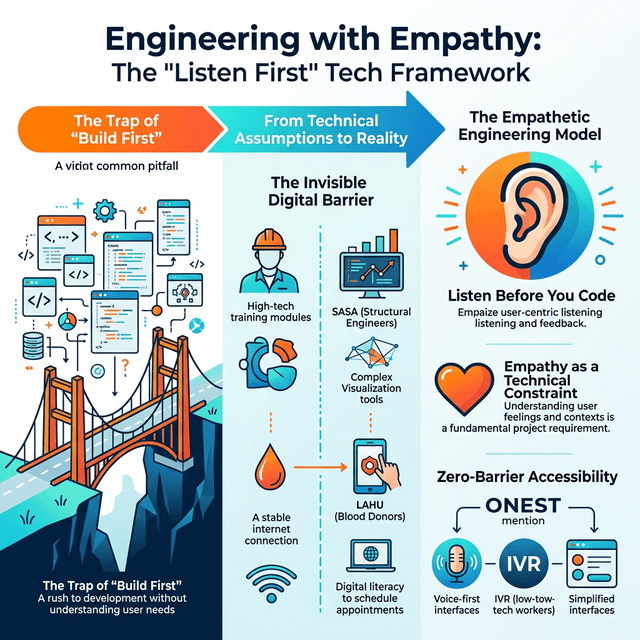
A year later, I had to step back. Not because the idea was wrong, but because I built before I listened. That's when I realized: technology creates impact only when it listens first.
Systems That Solve: SASA & LAHU
Over the past years, I've built projects to solve problems I saw around me.
One was SASA — Smart Architecture & Structural Analytics. It started as a 2nd-semester college project. I turned it into a startup, registered it under MSME, and today it's live, helping structural engineers with basic design calculations.
Another was LAHU, a blood donation ecosystem. It does real-time donor-recipient-blood bank matching with one-to-one mapping — something that doesn't really exist in India right now. It cuts through delays and connects people directly.
Both projects won recognition. But both assumed something: that users had smartphones, internet access, and digital literacy. That assumption changed everything.
A Defining Experience: Team Vidyut
It was my first hackathon as Team Vidyut. A bunch of Vidyutens, 50% GenZ, with one attitude: "Let's energize this."
The challenge: Zero-Barrier Job Applications for Low-Tech Workers.
My solution was voice-first. Workers could register and apply using just a missed call, SMS, or WhatsApp voice note. I integrated IVR systems powered by BHASHINI for real-time speech recognition across 22+ Indian languages. No forms, no apps, no literacy required.
During the hackathon, I did a field trip and talked to a village sarpanch. That's where I got the real insights. My teammates — Raheel, Bhumika, and Disha — and I were all in the same mindset.
We placed 3rd, but the real win was the lesson. As Bhumika said: "Always put your thoughts in front of your group and listen to them. Whenever you feel stuck, there's no bad in asking experienced people to help out."
SASA works great if you're a civil engineer with technical training. LAHU works great if you have a smartphone and internet. But ONEST forced a different question: what if the people who need technology most can't access it the way we build it?
Leadership Meets Engineering
Beyond code, I coordinate student initiatives as the State Convener for Think India. It's not just about organizing events; it's about aligning colleges, schedules, and priorities.
In late 2025, I organized Code Bharath Hackathon — 125+ teams, 50+ colleges, 4 days. SASA Engineers powered the technical backbone. But the hardest part wasn't the tech — it was the coordination.
What leadership taught me is that scale is technical + organizational + human. Perfect code doesn't matter if people don't trust the system or each other.
Why I Believe in Responsible Technology
Through SASA, LAHU, and ONEST, I've come to see technology as a bridge. Responsible technology means designing for accessibility not just efficiency, ensuring inclusion is a core requirement rather than an afterthought, and treating empathy as a primary engineering constraint.
Looking Ahead
I don't have formal academic publications yet. I believe ideas must first be lived and tested. This blog is a reflection of work done and questions worth carrying forward.
My goal is simple: To contribute to a future where technology listens before it speaks. Not just to users, but to collaborators and ground realities.
I'm still learning what that means. But I'm committed to the journey.
#Technology #Inclusion #Entrepreneurship #SASA #ThinkIndia #TeamVidyut