Why I Built ClauseWala
From Frustration to “Technology That Listens”
Every startup begins with a problem. ClauseWala began with a pattern.
I kept seeing the same thing happen over and over again in Indian startup circles. Founders copy-pasting NDAs from Google, freelancers signing contracts they didn’t fully understand, and early teams using U.S.-based templates for Indian agreements. People were relying on “hope this works” instead of local clarity.
Legal paperwork wasn’t just confusing. It was intimidating.
The Real Pain Point
The problem wasn’t the lack of documents. There are thousands of templates online. The real issue was that no one knew if the document actually fit their situation.
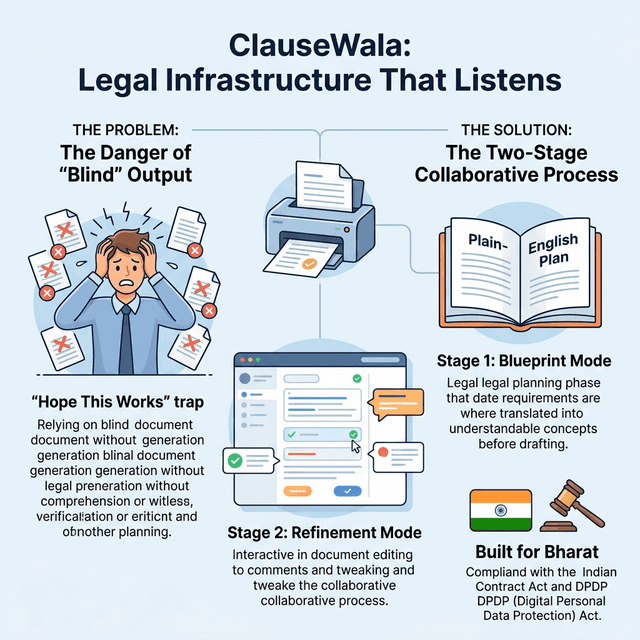
Most AI tools made this worse. You type “Generate an NDA for my startup” and it instantly gives you five pages. But does it align with Indian law? Is the jurisdiction correct? Are the clauses balanced? Did it include something unnecessary or miss something critical?
There was no explanation. No reasoning. No listening. Just output. And when it comes to legal risk, blind output is dangerous.
The Moment It Clicked
I realized something simple: Founders don’t want long documents. They want clarity before commitment. They want to understand what is being added, why it matters, what risk it reduces, and what flexibility it allows.
That’s when the idea formed. What if legal AI didn’t just generate? What if it explained first?
Building “Technology That Listens”
ClauseWala was built around one principle: The AI should show its thinking before writing the contract.
I designed a two-stage system:
1. Blueprint Mode
→ Before generating, ClauseWala presents a structured plan
→ Clauses to be included are explained in plain English
→ Legal relevance in the Indian context is highlighted
No surprises. No black box.
2. Refinement Mode
→ You adjust before expansion
→ You tighten specific clauses or change jurisdiction
→ You clarify scope directly in the draft
Only after alignment does the final draft generate. It’s not one-shot automation — it’s collaborative drafting.
Why India Needed This
Most global legal tools are built with U.S. assumptions. Indian startups operate differently. Founders in India deal with Indian Contract Act realities, evolving DPDP compliance, and different enforceability standards.
ClauseWala was designed for this ground reality. Built for Bharat.
The Bigger Vision
I’m not trying to replace lawyers. I’m trying to reduce confusion. I want founders to enter conversations informed, understand risk before signing, and move fast without being reckless.
Legal shouldn’t feel like a wall. It should feel like infrastructure.
Where I Am Now
ClauseWala is in Public Beta. I’m building in the open and listening to founders. Because the mission isn’t just document generation — it’s building technology that listens.
#ClauseWala #LegalTech #Founders #Bharat #AI #SystemsThinking