YUVA Validate — Four Weeks of Building, Breaking, and Awakening Infrastructure
I started YUVA Validate with two ideas, two teams, and zero clue what validation actually meant.
Four weeks later, I walked out with one validated idea, a bunch of rejected assumptions, the SASA Engineers logo, and the knowledge that I've been making coffee wrong my entire life.
Here's what actually happened.
Week 0: Two Ideas, Two Teams
Going in, I had two bets.
SASA Engineers — me (CEO), Viraj (CTO), Nihal (COO). "Infrastructure is Awake." AI-powered structural engineering platform. We'd already won 1st prize at a college hackathon. MSME registered. The tagline: "Code to Concrete — Bridging Computer Science and Civil Engineering through AI."
Haazri — me (Tech Lead), Bhumika (Head of Operations), Disha (Marketing & Community), Raheel (Product). Voice-first hiring platform for India's blue-collar workforce. The tagline: "Apna Pehla Kaam, yahin se."
Two teams. Two completely different markets. Four weeks to see what survives.
Week 1: Pitch Decks (Before Reality Hit)
Week 1 felt exciting. No customer calls yet. No validation pressure. Just ideas, ambition, and decks.
For the first time, we had to take the things living in our heads and explain them like real startups.
SASA
We walked in with a bold idea: AI for structural engineering.
The deck talked about India's broken construction workflows, manual calculations, seismic vulnerability, and the lack of digitisation in SME engineering firms. We introduced SASA as an AI-Powered Structural Engineering Platform & Intelligent Construction OS.
We already had pieces of the vision clear:
- →Auto-BIM generation in under 5 minutes
- →IS Code compliance automation (IS 456, 800, 1893, 875)
- →Failure mode prediction
- →Digital twins for disaster resilience
- →IoT-based structural monitoring using ESP32 nodes
- →AI as a "force multiplier," not a replacement for engineers
At that point, it sounded futuristic. Maybe even too futuristic.
But we believed in it.
The market slides were ambitious too — Rs. 16 lakh crore construction industry, less than 12% SME digitisation, and the idea that resilience assessment should become accessible to every municipality and engineer.
What we didn't have yet was proof.
No real validation. No customer conversations. No brutal questioning.
Just conviction.
Haazri
Bhumika took charge of operations and problem framing early. The core problem was simple but massive: India's blue-collar hiring ecosystem is broken.
Workers were locked out because of language barriers, literacy barriers, and complicated apps. Employers were drowning in unstructured WhatsApp replies. NGOs and HR teams had no proper tracking systems. The scale of the problem? 450M+ workers. Every stakeholder failing in isolation without a unified platform.
The solution we submitted in Week 1 was already surprisingly practical:
- 1Workers register through IVR
- 2Employers post jobs through WhatsApp, web, or IVR
- 3Workers receive local-language SMS matches
- 4Voice pitches get recorded and transcribed
- 5Employers review candidates through dashboards or WhatsApp
- 6Hiring decisions happen through SMS or IVR
No smartphone dependency. No literacy dependency. No "download our app first" nonsense.
The deck focused heavily on accessibility and Tier-2/Tier-3 scalability, especially around Hubli-Dharwad's industrial ecosystem.
And honestly? Week 1 made us feel confident.
The decks looked polished. The storytelling worked. The ideas sounded important.
We thought we were ready.
We weren't.
Because the next few weeks would force us to answer a much harder question:
"Will anyone actually care enough to pay for this?"
Week 2: Validation Essentials (Ground Work)
Week 2 was where YUVA Validate stopped being fun and started being real.
The curriculum covered three modules:
VE01: Problem Validation — Problem Before Solution
The core question: Is this problem worth solving? The best problems are frequent (happens often), popular (affects a lot of people), urgent (needs to be solved right now), and fast-growing (the number of people with the problem is increasing).
VE02: Solution Validation — Demo-Build-Sell
Don't start with an MVP. The goal is to create a "Mafia Offer" that guarantees demand before you invest in development. Test if people will pay for the idea of the solution, not just use a free version.
VE03: Market Validation — Market Demand Check
Build an Ideal Customer Profile (ICP). Interview at least 30 people to understand their goals, current processes, and specific pains. Emotions drive sales — logic just justifies the purchase later.
The instruction was clear: Go out. Talk to real people. Validate on the ground.
Haazri came out of the den.
We interviewed people. We met workers. We asked: "What's the actual problem? How do you find work now? What breaks?"
Some people we imagined as workers. We role-played scenarios. Made fun of ourselves (no offense). But we learned.
The insights were gold:
Monotonic reward system: Workers don't optimize for maximum wage. They optimize for continuity of income. A mason will take a lower-paying job over waiting for a better one. Workers set a preferred daily wage based on past earnings — but retain flexibility to opt for lower-paying jobs when needed. Our platform needed to support that, not fight it.
Automated work alerts matter more than fancy apps: A Masonry Mistri needed confirmed site address and contact name the night before — to eliminate wasted travel to wrong or cancelled sites. Semi-skilled mixer operators needed start time and mix ratios. Unskilled loaders needed daily wage confirmation via IVR before leaving home at 5am. Zero literacy required. Pure IVR/SMS. Maximum daily impact.
The market validated too — Hubli-Dharwad industrial belt alone: 2-3M blue and gray-collar workers actively seeking employment, 12-18M annual hiring match events, ₹60-270 Cr annual addressable market.
SASA hit a wall.
Our market isn't in Hubballi. Structural engineers? Architects who need AI-powered digital twins? Not many here. We couldn't find people to survey.
I talked to Satya about this. He gave me the move: "Tell the LLM you're a structural engineer. Ask it to generate responses based on that persona. Use that as proxy data."
We did. It worked enough to keep moving.
But the gap was obvious: Haazri was talking to real people. SASA was talking to AI.
Week 3: Problem Solution Clinic (The Grilling)
Then came PSC — Problem Solution Clinic at Deshpande Startups.
This is where ideas get broken.
SASA's turn
I had to represent SASA in a group discussion. Siddharth Mutkekar led the session. He didn't just ask questions — he grilled us.
"Who's your customer? How do they solve this now? Why would they switch? What's your revenue model? How do you know this problem is real?"
Every assumption we had? Challenged. Every vague answer? Called out.
"Infrastructure is Awake" sounds cool. 12,000+ simulations completed, <2% tolerance vs manual IS 1893 calculations, <5% variance from manual BOQ — the tech was solid. But who's paying for awakened infrastructure? How do you convince an SME to pay for earthquake simulation when they can't even afford full structural consultancy fees?
It wasn't mean. It was necessary. By the end, we knew exactly what we didn't know.
Haazri — The Turning Point
At the same time, Haazri was going through a different kind of grill.
"During the Problem-Solution Clinic, Manjunath Gogi pushed us to stop thinking broadly and start thinking where the value actually is. His line — 'paisa jaha ho waha socho' — stuck with us.
Using the pyramid approach, we learned to focus on the segment that is willing to work but lacks access, instead of trying to solve for everyone. He also emphasized community-based trust, real validation, and simplifying workers' lives.
That session gave us clarity — not just on the idea, but on who we are actually building for." — Bhumika
That moment changed everything.
Then came the storyboard session.
We were told to sketch our user journey. Visually. On paper.
Problem: We're three engineers who can't draw.
Solution: We took the paper and made 4 physical pillars. Built a miniature building structure out of them.
Sagar, Varadh, and the others made fun of us. Then helped us. Then motivated us to actually build something that made sense.
At the end, CMO ma'am (Disha) came over and helped us turn our 4 pillars into the 4 triangles that became the SASA Engineers logo.
We didn't draw our storyboard. We built it. Infrastructure is awake? Damn right it is.
Meanwhile, in Haazri:
Two artists (Bhumika, Disha) and their assistant (Raheel, who colored their sketches).
They actually drew a proper storyboard. Like normal people.
Their flow was clean: Worker dials IVR → Gets Job ID → Receives local-language SMS match → Presses 1 to apply → IVR callback records 30-sec voice pitch → Auto-transcribed for employer → Contractor reviews on WhatsApp dashboard → Hiring decision → SMS/IVR notification. Zero smartphone. Zero internet. Zero literacy barrier.
Week 4: Grand Presentation Day (And Everything After)
Morning chaos
We got to Deshpande Startups campus early. Sat in the reception. Started making the final pitch deck.
ChatGPT's image generation was down. We couldn't generate visuals for SASA's awakened infrastructure concept.
Panic mode. We asked GPT to write a prompt for NotebookLM to generate a pitch deck. It gave us 5 options.
Here's the thing about me and Nihal: we never follow the PPT during presentations anyway. We just talk.
So we picked one, ignored most of it, and kept moving.
Session with Manish Jaiswal
Before presentations, Manish Jaiswal (CEO, Deshpande Startups) gave us a session on validation vs defense.
He explained. He took questions. He made it clear: validation isn't about defending your idea. It's about proving it's worth building.
The Presentations
Team 1: SASA Pratibimbh — We presented "Awakened Infrastructure." The pitch: buildings that don't just get built, they get watched — simulating their own future, catching earthquake risk before it becomes a headline, adapting to how people actually use the space.
We broke it into four simple ideas:
- →Pratibimbh Core — the AI designs the full structure for you in under 5 minutes, instead of weeks of manual work
- →Raksha — checks how the building holds up against earthquakes, wind, and load, matched against manual calculations
- →Prakriti — a digital twin that watches buildings that already exist, catching problems before they become disasters
- →Manas — learns how people actually move and live in the space, so the building adapts to real behaviour, not just the original blueprint
The grilling was fair, and it landed on the one question we hadn't answered: who's actually paying for this, and when? "How do you reach architects? What's the switching cost? Why would someone pay for this today?" We didn't have a clean answer in the room — because architects pre-construction was never really the buyer with urgency or budget. We'd built something that sounded futuristic in the deck. We hadn't proven anyone wanted to buy it yet.
Team 2: Haazri — Bhumika, Disha, Raheel presented. Then Sandesh sir grilled them. Hard.
The problem? Systemic failure affecting 450M+ workers. The solution? Six-stage inclusive flow. The market? Hubli-Dharwad alone: ₹60-270 Cr annually. The pitch: "Demand is rising. Supply exists. But matching is broken."
Sandesh sir didn't accept vague answers. He pushed them to think twice before responding. By the end, Haazri's idea was sharper — because it survived the fire.
The Coffee Incident
After everything, me, Nihal, and Raheel went out for papad. Came back. Saw the coffee machine.
Satya told us we could use it.
Problem: None of us knew how to use a proper coffee machine.
First attempt: All three of us took Cappuccino. Added sugar. Tasted it. Not strong enough.
Solution: We made espresso. Added it to the Cappuccino. Made it strong.
Did we just invent something terrible? Probably.
Did it work? Also probably.
Desh Deshpande Session
We went down to the auditorium.
Desh Deshpande himself spoke about how to build and continue your entrepreneurial journey.
No generic startup advice. He talked about persistence, about validation as a continuous process, about building with purpose. About what it actually means to be an entrepreneur in India.
That session hit different.
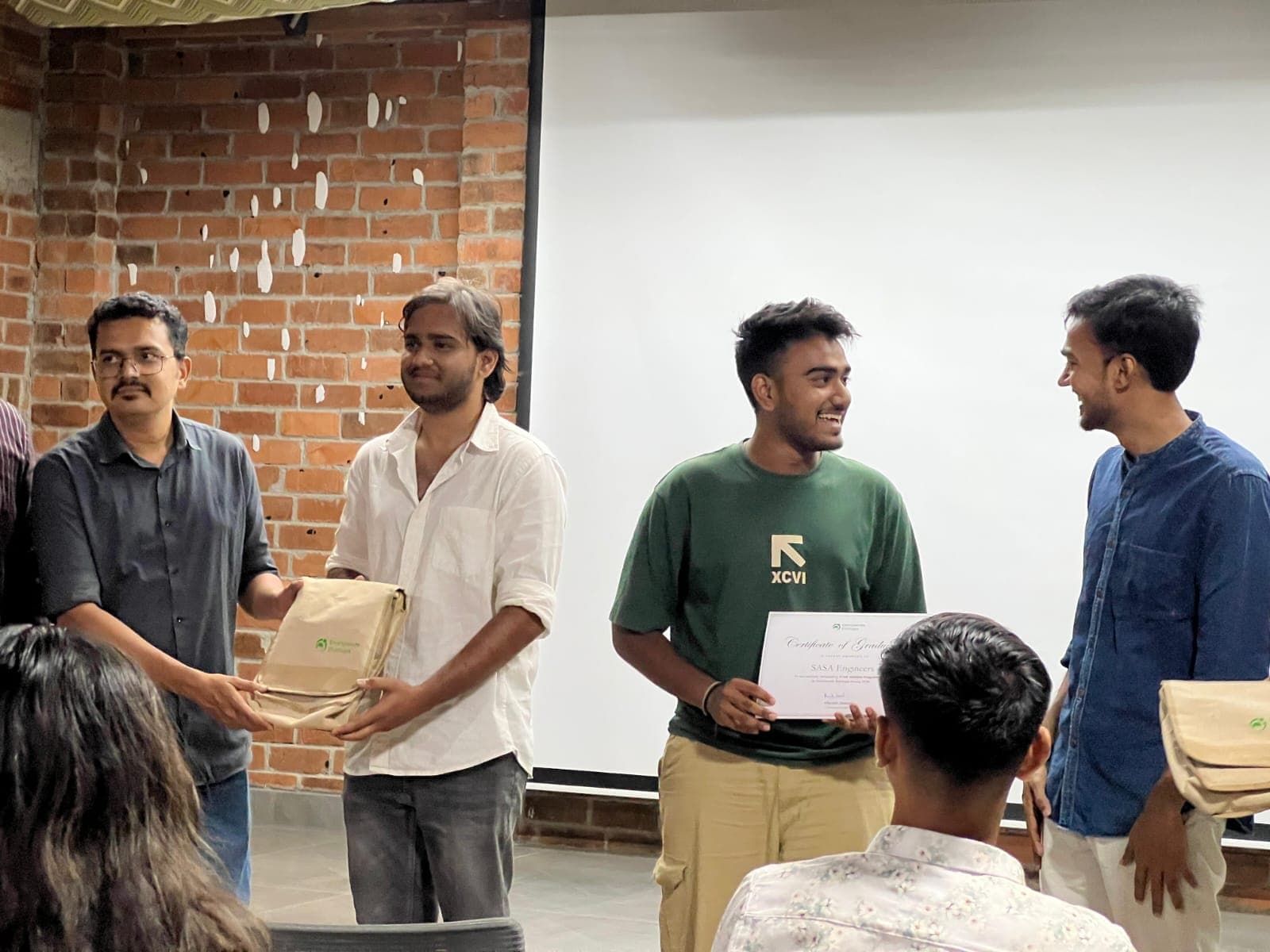
Graduation & Certificate Distribution
They called teams up.
Me and Nihal walked up for SASA. Then Haazri's team — me, Bhumika, Disha, Raheel — went up.
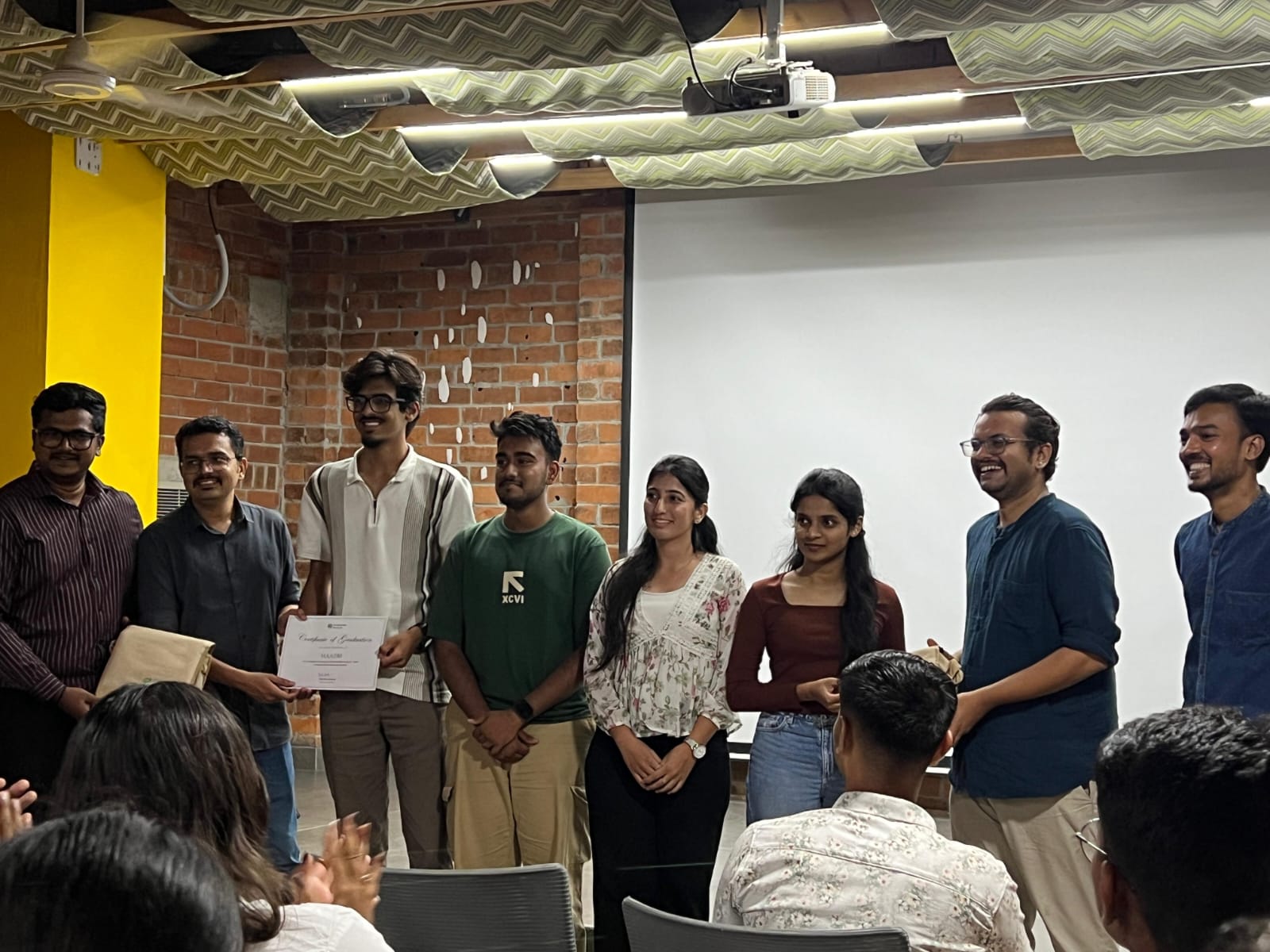
Four weeks. Two ideas. Both still standing.
Networking Dinner (That Wasn't Really Networking)
Then came the "networking" dinner.
Problem: 10+ people at the dinner were people I already knew.
So instead of networking, we just… hung out.
But at the end, we got to sit with Manish Jaiswal — CEO, Deshpande Startups — and tell him about both ideas. He listened. He asked questions.
He was impressed.
That conversation alone made the whole day worth it.
What I Learned
YUVA Validate wasn't about pitching. It wasn't about sounding smart. It was about proving your assumptions before you build.
Haazri survived because we talked to real people. We interviewed. We tested. We validated on the ground. The monotonic reward insight? The automated work alerts? "Paisa jaha ho waha socho?" Those came from actual workers and mentors, not our assumptions.
SASA struggled because we didn't have direct access to our market. We compensated with AI-generated insights and a technically solid platform — 12,000+ simulations, <2% tolerance, expert-validated. But we didn't prove the market wanted to pay for it. We built something impressive. We didn't prove someone would buy it.
The grilling sessions weren't mean — they were necessary. Siddharth, Manjunath, Sandesh sir, Manish — they didn't reject ideas to be harsh. They rejected bad assumptions so we could build better.
And honestly? That's the difference between building something that works and building something that looks good in a pitch deck.
Thank You
To the validation experts — Manjunath Gogi, Ajay Kabadi, Vinayak Hulabutti, Siddharth Mutkekar — for not letting us get away with vague answers.
To Desh Deshpande and Deshpande Startups for creating this space.
To Manish Jaiswal for the session, the dinner conversation, and the genuine interest.
To Satya, Sagar, Varadh, DS team , and everyone who helped us turn paper pillars into the SASA logo.
To my teams:
SASA — Viraj, Nihal. Infrastructure is awake. Now we need to wake up the market.
Haazri — Bhumika (the boss), Disha, Raheel. You validated the right way. "Apna Pehla Kaam, yahin se" isn't just a tagline. It's a real solution.
And to whoever designed that coffee machine: instructions would've helped.
What's Next
YUVA Validate taught me that validation isn't a one-time thing. It's continuous.
You validate the problem. Then the solution. Then the business model. Then the go-to-market.
Skip any step? You're just building something that sounds good — not something that works.
SASA's next move: We're not abandoning awakened infrastructure. But we're rethinking who pays for it and when. Maybe it's not pre-construction architects. Maybe it's government bodies post-disaster. Maybe it's insurance companies pricing seismic risk. Maybe it's municipalities that need affordable resilience audits for schools and hospitals. The tech is ready. The market positioning isn't.
Haazri's path forward: The problem is validated. The solution works. The market is massive. "Paisa jaha ho waha socho" — and we know where the money is. Now it's about pilot execution in Hubli-Dharwad's industrial belt.
Both ideas are still alive.
But now we know what questions to ask before we build.
And honestly? That's the most valuable thing we could've learned.